|

|
|
Empowering Toronto with a City Charter
Doug Ford’s latest overreach into municipal jurisdiction is another reminder that Canada's constitution was written when our country was largely an agrarian society. Large cities like Toronto are now responsible for delivering transit, roads, social housing, recreation, and other services residents rely on every day. Yet the province can overturn any of our considered and debated decisions on a whim. This constant meddling undercuts local democracy and threatens civic engagement.
Whether you agree or not with a new development, a bike lane, or a new tax, the level of government making the decision should be accountable to you. Toronto needs a new deal with senior levels of government that ensures we have the rights and abilities necessary for 21st century cities to thrive and achieve results for residents. Common in the United States and elsewhere, Charter Cities have supreme authority over “municipal affairs.” Also referred to as “Home Rule”, a Charter City’s law concerning a municipal affair will trump a state law governing the same topic.
It's time for Canada's largest city to have the tools it needs to effectively chart its own course to decide how we grow, get around, support each other, and improve our quality of life. A City Charter will also assist in making the division of roles and responsibilities between senior levels of government and City Hall more transparent and therefore more accountable to the public.
I will be moving a motion on this issue at the next meeting of City Council.
Protecting Tenants from Rent Price-Fixing
With vacancy decontrol and the Ford government’s removal of rent control on buildings constructed after 2018, Toronto renters are all too aware of escalating prices for vacant units and annual double-digit rent increases on an apartment they’re already renting. With a structural housing supply shortage driving rent inflation, landlords are said to pass on massive rent increases to tenants according to what the market will bear. But what if these large increases are not solely the machinations of the “free market”, but rather the product of illegal price collusion between landlords facilitated by the same algorithmric pricing software currently subject to antitrust investigations in the United States?
In the U.S., the FBI is investigating property management software company RealPage for illegal algorithmic rent setting through its software Yieldstar. The Department of Justice launched a lawsuit last August, claiming that the AI software allows landlords to collude on their rents, avoiding fair competition in the market. The influence of RealPage across U.S. rental markets was significant: it set roughly 60% of prices in the D.C. area, and 70% in Phoenix, Arizona.
A recent CBC investigation found that Yieldstar software has been in use by landlords and property managers in Canada since 2017. Reporting has documented its use by property management company GWLRA, as well as Dream Unlimited and its property manager Rhapsody Living. In response, the federal government recently announced that it is launching an investigation into price-fixing by landlords using algorithms through the Competition Bureau.
The full extent of this software’s use in the Toronto rental market is unknown, nor do we have a full picture of who is using it. That’s why I was successful in getting support for my motion that directed City Staff to employ all the tools at its disposal to ensure fairness for renters by taking action against landlords who cheat to illegally drive up their profits.
Putting the Breaks on Auto Theft: Taking Immediate Action to Keep our Neighborhoods Safe
Every night, too many Torontonians go to bed worried about whether their car will be stolen or if their home will be broken into.
The surge in auto thefts and home invasions has even led to some residents hiring private security at their own expense- personally spending tens of thousands of dollars in enhancing security measures for their properties and those of their neighbours. That’s not acceptable and concrete actions must be taken to protect our communities.
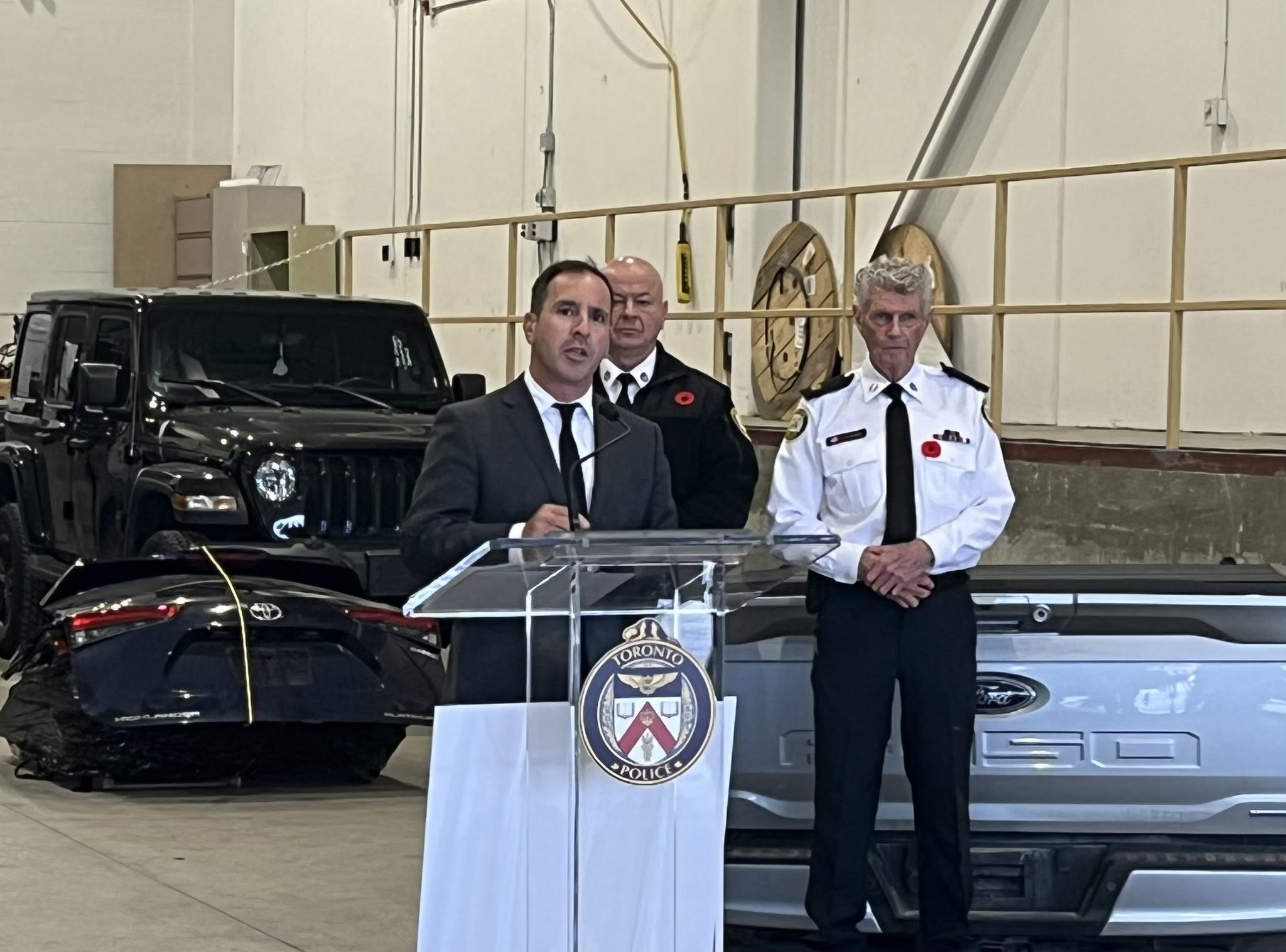
I was pleased to join Toronto Police Chief Myron Demkiw and Superintendent Ron Taverner to announce the ongoing results of Project Thoroughbred, an investigation into auto thefts and fraudulent Vehicle Identification Numbers (VINs), a number that uniquely identifies each individual vehicle.
Through Project Thoroughbred, investigators have uncovered a scheme involving the registration of fraudulent VINs by employees of Service Ontario. These fake VINs were used to sell stolen vehicles to unsuspecting buyers at a significant discount. The investigation has also revealed the existence of "chop shops" across the city, where stolen vehicles are dismantled and prepared for shipment overseas. Vehicles brought into these facilities are quickly dismantled, making them difficult to trace and reducing the chance of detection. Additionally, investigators recovered stolen vehicles from shipping containers destined for overseas locations. I remain in close communication with our Toronto Police Service and commend the work of our local police divisions on continuing to identify and arrest members of suspected auto theft rings. I’ve also met with the Vice President of the Insurance Bureau of Canada to learn more about their advocacy for policy and regulatory changes.
While there have been increased measures at our national borders and ports, and additional funding to help curb auto theft, there is much more that needs to be done.
This is why I moved a motion at City Council, that received unanimous support, on the following recommendations to senior levels of government:
The way to combat auto theft is to prevent it from happening in the first place by screening our ports, using technology and cracking down on fraud, along with bringing the perpetrators of these crimes to justice.
Every level of government needs to work together on concrete actions to support national, provincial and local police services’ efforts to protect our residents. This is a serious and all too common problem affecting cities across Canada -and will take an all hands on deck approach to get results.
|
